
When Software Stops Waiting for Your Instructions: The Future of Agentic Business
Most companies run plenty of software, yet people still move information between systems and decide what happens next. An agentic business redesigns how work flows between people, software and AI agents.
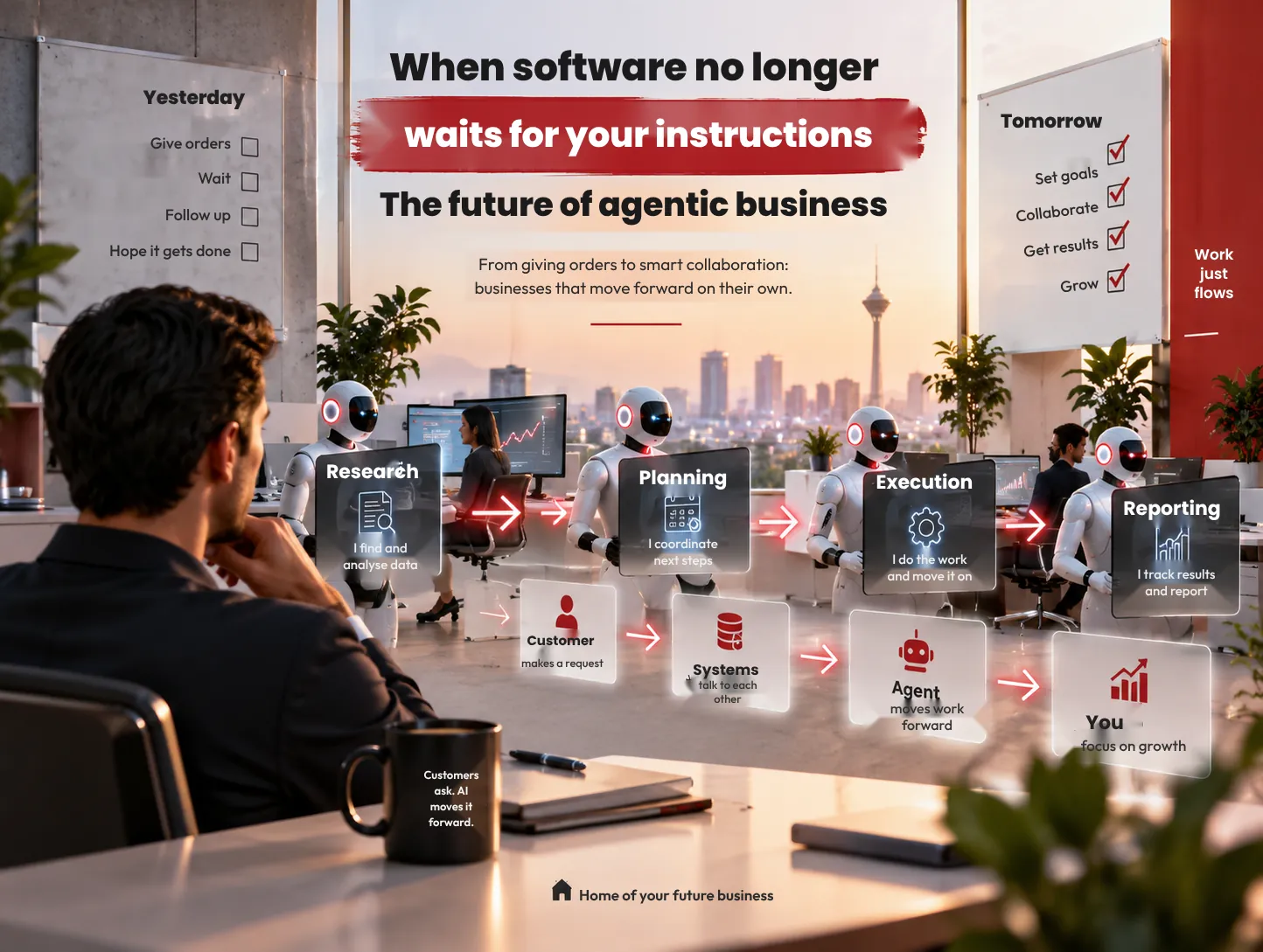
Imagine a company where work doesn't wait for people
It is 8:20 a.m. and the sales team has not yet arrived. Since last night, three new leads have come in from the website, a long-standing customer has sent a request for a quote, stock of one product has hit its warning threshold and the due date for an important invoice is approaching.
In an ordinary company, all these events sit waiting somewhere: in the CRM, in email, in the website admin panel, in the accounting software or perhaps in an Excel file. Nothing else happens until someone logs into the system, sees the information and decides what needs to be done.
An agentic company, however, can work on a different logic. An event happens, the system detects it, finds the relevant information, determines the next step and brings a person into the process only when their decision or approval is genuinely needed.
This picture is no longer just a futuristic idea. In 2026, IBM, Microsoft, Salesforce, Deloitte and other technology and consulting firms are exploring the concept of the agentic enterprise around exactly this shift in the organisation's operating model.
So the important question is not "What can an AI agent do?" The more interesting question is: when agents enter the real flow of work, how must the company itself change?
What does an agentic business really change?
An agentic business can be thought of as an organisation in which people, software and AI agents work within a shared operating model. IBM defines the agentic enterprise as an organisation that integrates agents across its functions so that they can plan and execute multi-step tasks and make decisions alongside human employees.
But the important part of the definition is not the agent itself; it is the flow of work. Installing a few AI tools on employees' laptops does not make a company agentic, just as having a CRM does not on its own make an organisation customer-centric.
A company moves closer to this model when it defines, for each process, which work is done by software, which by an agent and which decisions are made by people. This means that agentic transformation is less a technology-buying project and more a project of redesigning work.
Companies don't lack software; the problem is the gaps between software
A medium-sized company may have a CRM, accounting software, a website, a warehouse system, an SMS platform, corporate email and support software. Despite all these tools, a sales rep may still take customer details from the website, enter them into the CRM, ask a colleague about stock and then find the pricing information in another file.
Each system does its own job, but people fill the gaps between the systems.
That gap is one of the biggest opportunities for an agentic business. An agent can act as a coordinating layer that sees events, gathers information from authorised sources and moves the workflow forward between systems.
This issue is visible at a larger scale too. Salesforce's 2026 Connectivity Report states that 50 per cent of agents in the organisations surveyed still operate in silos — a situation that risks recreating the same problem of disconnected workflows and duplicated automation.
So the goal should not be to add yet another intelligent island. The real value is created when the gaps between the islands shrink.
What journey does a customer request take in an agentic company?
Suppose an industrial equipment company receives a new purchase enquiry. The customer has filled in the website form and written that their factory needs a specific piece of equipment.
In the current model, a sales rep sees the request, searches for the company name, checks the contact history in the CRM, asks about stock and then decides how to follow up the enquiry. A large part of their time is spent gathering context, not negotiating with the customer.
In the agentic model, an agent can recognise the request, find the customer in the CRM, review previous purchases, read the stock position from the relevant system and prepare the information the rep needs. If certain low-risk actions have been pre-approved, it can carry out those steps as well.
When the case reaches the rep, they do not start from scratch. Human time is spent precisely where human experience, negotiation and judgement create the most value.
What will the manager of the future manage instead of tasks?
Much of today's management is built around tasks: who should do this, has it been done, why is it behind schedule and whose turn is it next?
If agents can drive part of the workflow, the manager's role changes too. Managers will need to make more decisions about goals, boundaries of authority, exceptions, success metrics and the hand-off points to people.
For example, instead of the sales manager checking every day which leads have not been followed up, they need to define what makes a lead important, when follow-up is essential and under what conditions the agent is allowed to act.
McKinsey's September 2026 research on value creation from AI also emphasises that agentic AI changes how decisions are made, how work is carried out across departments, how capabilities are developed and where value is created. From this perspective, the core issue is designing the right operating model.
The manager of the future will not only manage people; they may be the manager of a hybrid system of people and agents.
What do employees do in an agentic business?
The arrival of agents does not necessarily mean eliminating an entire role; sometimes, more important than the number of jobs is how the mix of tasks within each job changes. Employees may spend less time gathering information and on repetitive coordination, and more time on exceptions, human relationships and complex decisions.
In its analysis of the agentic workforce, Deloitte points to roles shifting from execution and monitoring towards orchestration, oversight and strategic decision-making. From this point of view, collaboration between people and AI requires roles and skills to be redesigned.
For example, the support specialist of the future may no longer handle every request from start to finish. A more important part of their expertise may be dealing with cases the agent could not resolve with sufficient confidence.
This creates an interesting concept: managing exceptions instead of managing repetition.
Will every employee have a team of agents in the future?
Today, when we say "AI assistant", we usually picture a single tool. But the future model could be more specialised: one agent for research, one for analysis, another for execution and another for reviewing output.
In such a model, a sales manager might have one agent for researching customers, one for the pipeline and one for preparing follow-ups. The employee is no longer merely a "software user"; in a sense, they become the leader of a small digital team.
Deloitte, in its review of the future agentic workforce, also talks about structures in which teams can be a mix of people and specialised agents.
If this trend continues, one of the management skills of the future will probably not just be managing people; it will be dividing work correctly between people and machines.
What happens when agents work with each other?
The next stage is even more interesting. Instead of one all-purpose agent, several specialised agents can collaborate towards a shared goal.
The sales agent receives the customer's request, the inventory agent checks product availability and the finance agent assesses the customer's credit limit. The result is then handed to the responsible person for the final decision.
This is where the concept of a multi-agent system turns from a technical term into an organisational design question. The question is no longer just "what does this agent do?"; we need to define how agents hand over responsibility and, if two agents reach different conclusions, which rule determines the final decision.
This issue is already becoming serious. Salesforce has reported that the organisations it surveyed in 2026 use an average of 12 agents, while also stressing the need for an integrated architecture to prevent agent sprawl.
How do the economics of an agentic business differ?
One of the most interesting consequences of this shift is a change in what operational capacity means. In the traditional model, an increase in customers or transactions usually leads to an increase in headcount and operating costs.
Agents can change that relationship in some processes. A team of ten might be able to handle a greater volume of work, because part of the research, categorisation, coordination and preparation is done by the system.
In this situation, new KPIs also become important: cost per workflow, time to resolution, percentage of work completed without human intervention, escalation rate and revenue per employee.
So the value of an agentic business should not be measured only by "how many hours of staff time were saved?" The more interesting question is: what volume of work can the same organisation now handle that it couldn't before?
Can a small company be more agentic than a large one?
A large company has more capital, data and specialist staff, but it also has one problem: legacy.
Dozens of old applications, separate databases, complex permissions and workflows built on top of one another over the years make connecting agents difficult.
A smaller business may have a different opportunity. If it designs its software architecture, CRM, data and workflows for integration and automation from the outset, it can reach an agent-ready structure more quickly.
So in this race, size is not the only advantage. Architectural simplicity and the ability to redesign processes can also be a competitive advantage.
Why is the biggest obstacle to becoming agentic not AI itself?
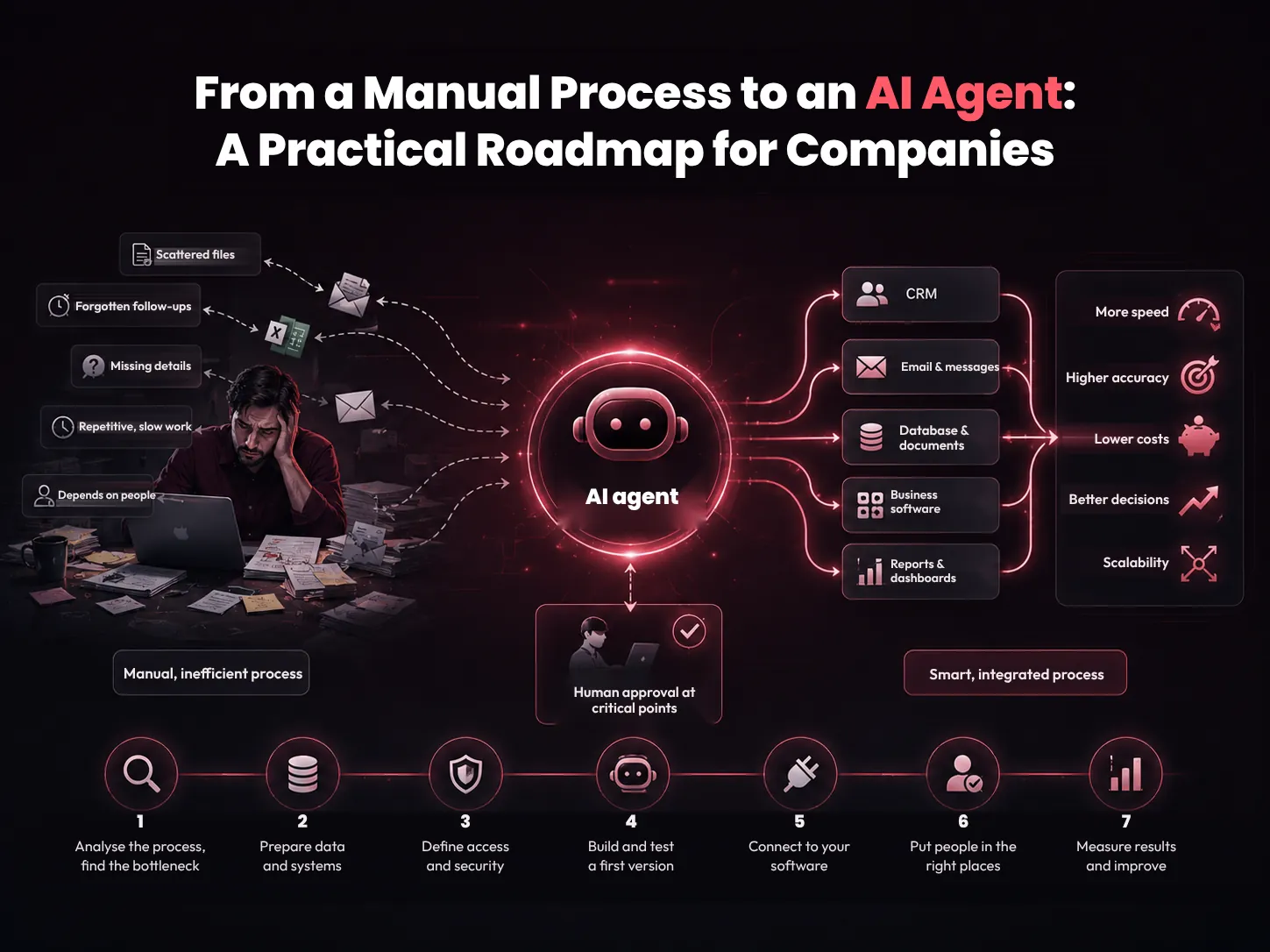
Building an agent demo has become relatively easy. Building an agent that can work every day with the company's real data, correct permissions and controlled errors is a completely different matter.
Scattered data, incomplete APIs, undefined processes, unclear responsibilities and a lack of governance can quickly bring a project to a halt. In its 2026 operating model framework, IBM likewise presents agents, data, automation and infrastructure/governance as interconnected components of an organisational model.
Deloitte's figures make the gap clearer. Only 5 per cent of the organisations surveyed said their business processes were highly ready for agents, and only 15 per cent had achieved coordinated, multi-task use of multi-agent systems at scale.
So the bottleneck of the future may not be making agents smarter, but making organisations readier.
How do you know whether a process is ready to become agentic?
For each workflow, you can ask five simple questions: how often is this process repeated? How accessible is the data it needs? How definable are its decisions? How far can the next action be carried out by a system? And how much risk does the cost of a wrong decision create?
Suppose the sales team categorises 100 leads a day. The information is digital, the initial criteria are clear and the agent's mistakes can be controlled through the rep's approval before any sensitive action; this could be a good candidate for a pilot.
By contrast, the final negotiation of a major, high-value contract that depends on human relationships, market conditions and a manager's judgement is not a suitable place for full agent autonomy.
A good rule is: start with work that is highly repetitive, has suitable data, a measurable output and controlled risk.
Why is the first step not buying an AI tool?
Imagine we map a workflow on paper and discover that the information for an order has to pass between five people and four applications before it is complete. The first question should not be "which AI agent should we buy?"
A better question is: why does this process involve so much back-and-forth?
Sometimes removing a step, connecting two APIs or building a simple automation creates more value than an agent. In other cases, an agent is exactly the layer that can gather context from several systems and smooth the way to the next decision.
In Zonan System projects, too, the logical starting point for a problem like this is analysing the workflow, the data and the integrations. Once the bottleneck is clear, a decision can be made as to whether the right solution is custom software, automation, an AI agent or a combination of all three.
Technology should be the outcome of analysing the problem, not its starting point.
The future may not be a company without employees, but a company without "work queues"
For years there has been talk of a future in which AI pushes large numbers of employees aside. Perhaps there is a more important picture: a company in which work waits less.
A lead is not forgotten in the CRM for three days. A customer request does not sit in the inbox until the next morning, and a manager does not have to gather information from four departments to understand a problem.
In such a company, an event becomes a workflow, the workflow moves forward as far as possible and a person steps in precisely at the point where human judgement, experience, creativity or responsibility is needed.
In its 2026 research, Deloitte reports that 74 per cent of the leaders surveyed expect nearly half of their business processes to be redesigned or rebuilt around AI agents within the next four years. In the same study, 75 per cent believed that collaboration between people and agents creates more value than purely agent-based automation.
If this path continues, the company of the future is not necessarily an organisation with fewer people; it may be an organisation that spends less human time on waiting, moving information around and repetitive tasks.
Conclusion: an agentic business means redesigning how work gets done
The most important transformation brought by AI agents may not be the agent itself. The deeper change happens when a company decides afresh who should carry out each step of the work: a person, traditional software or an agent?
In this model, managers do not just allocate tasks; they design the rules and boundaries of decision-making. Employees do not just carry out repetitive steps; they manage exceptions and higher-value decisions. And software no longer simply waits for the next human click.
This is what turns the agentic business from a technology trend into a management issue. Companies that simply add agents may create a new set of scattered tools; companies that redesign their workflows have the chance to build a different operating model.
For leaders, the starting point can be a simple question:
In our organisation, which piece of work stalls simply because it is waiting for someone to look at the information and move it on to the next stage?
If you find the answer to that question, you have probably also found your first real agentic business use case.
The Zonan System team can review processes like these from the perspective of workflow, software, data, automation and AI to determine which parts are genuinely worth making agentic. The ultimate goal is not to build more agents; it is to build a business in which work flows more intelligently. Talk to us about where to start.
Frequently asked questions
What is an agentic business?
An agentic business is an organisation in which people, software and AI agents collaborate in carrying out business processes. Agents can plan and execute parts of multi-step work within defined limits of authority.
What is the difference between an agentic business and automation?
Automation usually runs a defined workflow based on predetermined rules. Agentic AI can, in some scenarios, examine context, choose between several paths and use different tools to achieve a goal.
Does every company need an AI agent?
No. If a process is simple and rule-based, ordinary automation may be the better choice; an agent is more valuable when a workflow requires context, information gathering, choosing a path or coordinating several systems.
What is a digital workforce?
A digital workforce refers to the organised use of agents and software systems to carry out part of the work alongside human staff. In the agentic model, people and agents can play different roles within a shared workflow.
What is a multi-agent system?
A multi-agent system consists of several specialised agents that coordinate with one another to achieve a larger goal. For example, sales, finance and inventory agents can each review different parts of a customer request.
How does the manager's role change in an agentic business?
Part of management's focus can shift from chasing repetitive tasks towards defining goals, KPIs, the boundaries of agent authority, exception handling and governance. Managing the performance of people and agents side by side also becomes more important.
How do we know whether a process is suitable for an AI agent?
High repetition, accessible data, reasonably definable decisions, the ability to connect to systems, measurable output and controllable risk are all good signs that a use case is worth exploring.
Zonan System Team
Software & AI team
Developers, designers and AI engineers at Zonan System, writing about practical AI, software development and digital business.
Need advice for your project?
Zonan System experts will guide you for free.

Comments (0)
Be the first to comment.