
From Manual Process to AI Agent: A Practical Implementation Roadmap for Companies
Implementing an AI agent should start with a real, measurable business process, not a model or tool. Follow this ten-step roadmap from mapping the process to measuring ROI.
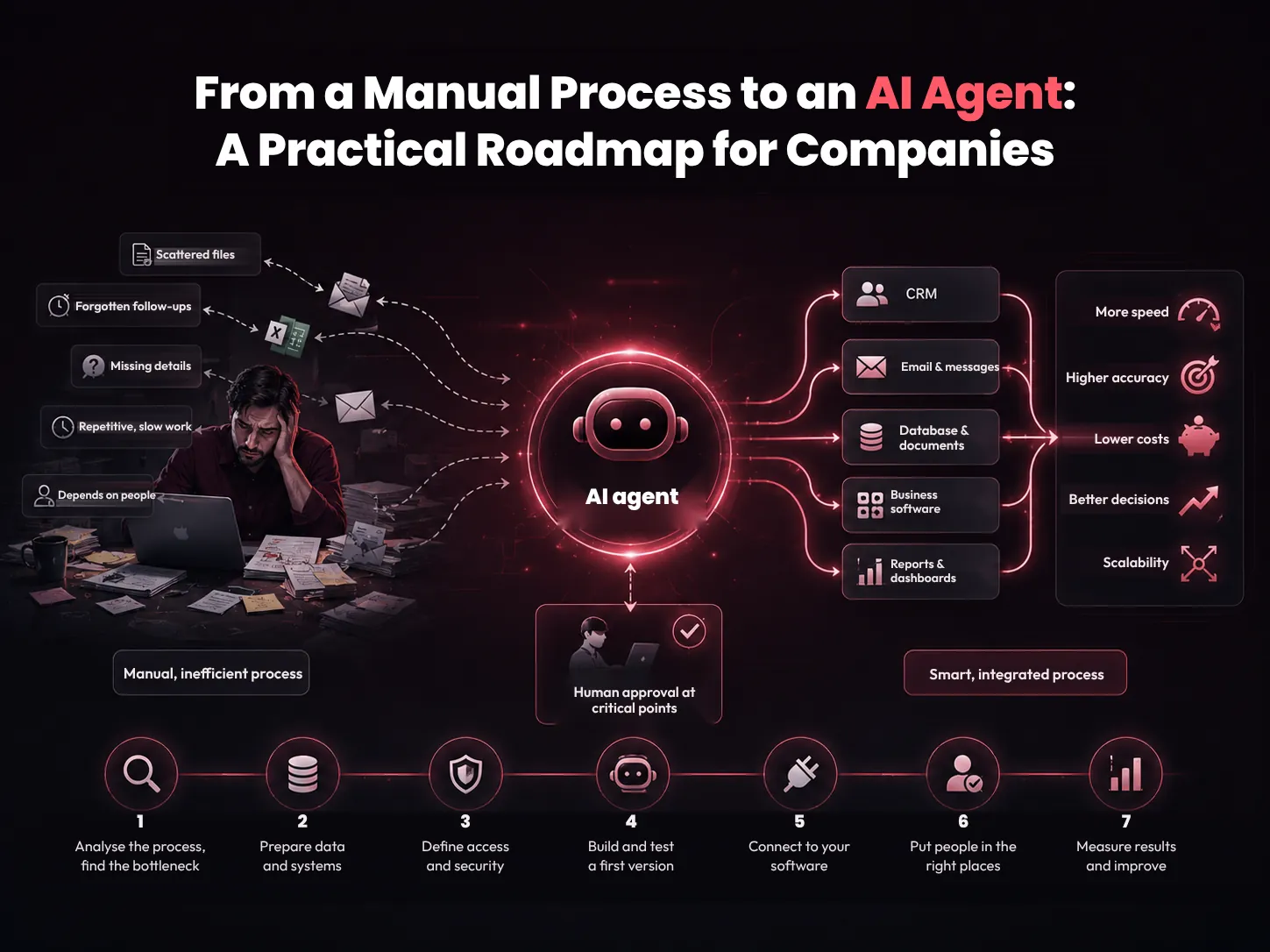
It is 9 a.m. A sales rep opens the customer file, reads through yesterday's messages and tries to remember which customer said "call me next week". Shortly afterwards, a colleague asks on the messaging app for the latest status of a particular customer's order. Finding the answer means checking the CRM, a few messages and probably another Excel file.
By 11 a.m., one customer has not been followed up, a request is sitting in the email inbox and the report the sales manager wants is still not ready.
Nobody has necessarily been slacking.
The problem lies elsewhere: a process that should be managed by a system still depends on people's memory and personal follow-up.
In situations like this, an attractive suggestion usually comes up: "Let's build an AI agent for it."
But this is exactly the point at which many AI projects set off in the wrong direction.
Implementing an AI agent should not start with choosing a model, subscribing to a tool or building a chatbot. The starting point is the business process itself.
If the process is broken, unclear or lacks data, adding AI just makes the same chaos happen faster.
So the question in this article is not "how do we build an AI agent?"
The more practical question is:
How do we turn a real company process, step by step, from a manual one into an intelligent, controllable one?
Should we really start with an "AI agent"?
No — and that short answer alone can prevent a great deal of expense.
The first mistake is choosing the technology before the problem.
A manager sees other companies talking about AI agents and asks: "Where can we have an AI agent?"
A better question is:
Which company process is currently costing us a lot of time, money or opportunity, and could AI do part of it better?
The answer may not be an AI agent at all.
Sometimes a better form, a simple connection between two applications, a few clear rules in the CRM or ordinary automation will solve the problem.
On the other hand, some processes genuinely need more than a few fixed rules. The system has to read different pieces of information, analyse the situation, decide what action is appropriate, use a specific tool and choose the next step based on the result.
This is where an AI agent makes sense.
So before building an agent, we need to understand how it differs from ordinary automation.
How does an AI agent differ from ordinary automation?
Traditional automation is usually built on fairly clear logic:
If event "A" happens, do task "B".
For example, if the website form is completed, enter the customer's details into the CRM and send a message to the sales rep.
This kind of automation remains extremely valuable, and many companies are still not using its full potential.
An AI agent creates more value when, between the input and the action, there is a need for interpretation, decision-making or choosing a tool.
Suppose a customer request comes in.
The agent can read the text of the request, identify its subject, review the customer's history, find relevant information in the system, suggest the next action and, within the scope defined for it, carry that action out.
The difference can be simplified as follows:
| Approach | How it works | Best suited to |
|---|---|---|
| Manual process | A person decides and carries out the work | Variable tasks with no system in place |
| Traditional automation | Predefined rules are executed | Repetitive, predictable tasks |
| AI agent | Interprets information and decides between permitted actions | Semi-structured, multi-step processes |
So the goal should not be to replace every automation with AI.
The goal is to find the right combination of people, software, automation and AI.
But which process is worth starting with?
Which company process is the best starting point for an AI agent?
Suppose a company has 30 manual processes. We are not going to build 30 AI agents on day one.
It is better to choose a process with three characteristics:
High frequency + significant cost or time + a measurable outcome
For example, these processes are usually worth examining:
- Categorising and giving an initial response to customer requests
- Following up sales leads
- Extracting information from documents and invoices
- Preparing recurring reports
- Initial screening of CVs
- Gathering information from several systems
- Entering and updating data in software applications
- Summarising conversations and creating the next task
- Initial checking of documents against defined rules
There is also a simple test.
Ask your employees:
"Which task do you do every week that is repetitive, takes a lot of time and that you would love not to have to do yourself any more?"
The answers to this question are usually a goldmine of use cases.
But being repetitive is not enough on its own.
Which processes are not good candidates for now?
A process that is carried out twice a year, has no clear data, is completely different every time, or where a mistake could have very large legal and financial consequences, is probably not a good first choice.
Likewise, if the team itself cannot explain how the current process works, AI is not going to sort it out by magic.
So once a suitable candidate has been chosen, the first job is not a technical one.
We need to pick up a pen and paper.
Step one: before AI, put the process on paper
Let us assume the sales team's problem is following up customers.
Saying "follow-ups are weak" is not enough to design a system.
We need to unpack the real process:
Where does the customer come in from?
Where are their details recorded?
Who makes the first call?
Where is the outcome of the call written down?
How is the next follow-up date set?
What happens if the rep forgets?
How does the manager find out about neglected customers?
When this journey is put on paper, interesting things usually come to light.
For example, we discover that the customer's details are first in the website form, then sent via a messaging app, then the rep records part of them in the software and writes the next follow-up date in their personal calendar.
This means that before we have an AI problem, we have a process and data problem.
Experience of designing enterprise systems shows that a significant part of the initial analysis lies exactly here. At Zonan System, too, it makes more sense for intelligent automation projects to begin with process analysis rather than choosing a language model, because until the workflow is clear, it is impossible to determine what the agent should see, what decisions it should make and what it should have access to.
Now that we can see the process, we can find the real bottleneck.
Step two: find the real bottleneck, not the most attractive part
Not every manual step needs to be automated.
Sometimes a task takes 30 seconds and is done five times a day. Automating it might be technically interesting, but it creates little economic value.
By contrast, sales reps may collectively spend three hours a day finding information, reviewing previous conversations and deciding on the next follow-up.
That is where the real opportunity lies.
For each step, ask three questions:
How often does it happen?
How long does it take?
How much does a mistake in it cost?
Then add a fourth:
If this step became faster or more accurate, which business metric would improve?
If we have no clear answer to the fourth question, the project may be nothing more than an attractive AI demo.
But finding the bottleneck still does not mean handing all of it over to an AI model.
Step three: decide which tasks need rules and which need intelligence
One of the best ways to control cost and complexity is to separate deterministic tasks from interpretive ones.
For example:
"If the customer has not replied within 48 hours, create a follow-up task."
This probably does not need a language model.
But:
"Based on previous conversations, identify the likely reason for the customer's hesitation and suggest the most appropriate next action."
Here, using an AI model makes more sense.
Good architecture does not hand everything over to AI.
The deterministic parts are handled by software and rules; the parts that require understanding language, extracting meaning, classification or decision-making in changing circumstances are handed to the model.
This separation usually makes the system cheaper, faster, more predictable and more controllable.
Now we can turn to the main fuel for such a system: data.
Step four: where will the AI agent get its information from?
Without the right context, an agent is just a general-purpose model.
If it is meant to analyse a customer's situation, it will probably need some of the information in the CRM.
If it is meant to answer support requests, it may need the knowledge base and the history of previous requests.
If it is meant to check order status, it must be connected to the sales software or the ERP.
So for each use case, prepare a data map:
| Agent requirement | Source |
|---|---|
| Customer details | CRM |
| Previous conversations | Support system or messaging app |
| Order status | Sales system |
| Company policies | Knowledge base |
| Stock | Warehouse |
| Invoices | Accounting software |
But there is one very important point:
An agent should not be given access to all information simply because it could have access to it.
If only order status is needed, there is no justification for access to all of the customer's financial information.
This takes us from "data" to one of the most important architectural decisions: the level of authority.
Step five: how far is the AI agent allowed to go?
Not every agent should be autonomous.
The level of authority can be defined in stages.
Level one: observe only
The agent reads and analyses information but makes no changes to the system.
Level two: recommend
The agent recommends an appropriate action and a person makes the final decision.
Level three: act with approval
The agent prepares the work but waits for human approval before carrying out sensitive operations.
Level four: act independently within a defined scope
The agent is only allowed to act automatically for low-risk, predefined operations.
For many companies, starting at level two or three makes more sense than granting full authority.
For example, the agent can draft an email reply, but the rep approves sending it. After several thousand interactions and quality measurements, some low-risk replies can be automated.
This approach has an important advantage:
Trust in the system is built gradually and with real data, not with hope.
And the same logic should apply to the size of the initial project.
Step six: solve a small problem first, not the whole company
A project with this kind of title is usually dangerous:
"We want to make the entire sales process intelligent."
The scope is unclear, success is undefined and every department probably has different expectations.
By contrast:
"We want to identify leads that have not been followed up after the first call and suggest the appropriate next action to the rep."
This is a testable project.
For the initial version, the following must be clear:
What is the input?
What does the agent do?
Which tools does it have access to?
What is the output?
What number will we use to measure success?
The first version does not need to be beautiful or complete.
It needs to prove one thing:
Does this solution genuinely improve the process?
If the answer is yes, then it is time for deeper integration with the company's infrastructure.
Step seven: connect the agent to the company's real software
An AI agent that lives only in a chat window has limited value for many business processes.
Serious value is created when it can work with existing systems within a controlled scope.
This connection is usually made through APIs.
The agent may need to read customer data, check an order, create a task, record a report in an admin panel or transfer specific data to another application.
At this stage, one of the real challenges many companies face appears: not every application has a suitable API, and information is sometimes spread across several legacy systems, Excel files and manual processes.
In such situations, the challenge is no longer just "building an agent".
We may need a custom software layer that connects existing systems, data, business rules and AI.
This is where software development and AI effectively become a single project.
Step eight: don't remove people — change their role
One misconception about agents is measuring a project's success by the number of people removed from the process.
There is a better measure:
How much of people's time has moved from low-value tasks to high-value decisions?
Suppose a support agent receives 100 requests a day.
If the AI agent can categorise requests, find customer information, prepare an initial response and flag sensitive cases, the support agent no longer has to repeat the same process from scratch 100 times.
But complex cases still reach a person.
This is what human approval and oversight means.
The goal is not to build an organisation without people.
The goal is to build a process in which people do not have to do work that a machine can do to an appropriate standard.
And the more authority the machine has, the more serious the question of security becomes.
Step nine: don't bolt security on after building the agent
If the agent only produces text, the potential damage from a mistake is fairly limited.
But if it has access to email, files, the CRM, databases or APIs, the situation changes.
Here, the principle of least privilege must be applied.
The agent should only have access to the information and tools it needs for that specific task.
Sensitive operations must also be restricted. Deleting data, transferring confidential information, making payments or changing user permissions should not be handed to a model without proper controls.
Our article on AI agent security explores this topic in more depth, from sandboxing and runtime isolation to network control and human approval.
The management rule, however, is simple:
Don't design the system on the assumption that the agent will never make a mistake; design it so that if it does, it cannot cause major damage.
Now only one question remains: how do we know whether all of this was worth it?
Step ten: measure the AI agent's success with numbers
"It works really well" is not a metric.
"The team is happy with it" is not enough on its own either.
Before the project goes live, record a few baseline figures.
For example:
What was the average response time before implementation?
How many hours a week did each rep spend on manual work?
What percentage of leads went without follow-up?
What was the cost of processing each request?
What was the human error rate?
Then measure the same metrics after the agent has been deployed.
For example:
Before: 12 minutes to review each request
After: 4 minutes to review each request
Or:
Before: 18 per cent of leads without follow-up
After: 6 per cent
At this point we are no longer talking about AI being "impressive".
We are talking about return on investment.
And that is exactly the point at which a technology experiment can become a real business capability.
A real-world scenario: from manual sales follow-up to an AI agent
Suppose a services company receives 800 new leads a month.
The details go into the CRM, but what happens next depends largely on the reps.
One customer says:
"The price is good — let me talk to my business partner. Call me on Tuesday."
The rep makes a note.
Tuesday is busy and the call doesn't happen.
On Thursday, the customer buys from a competitor.
The problem was not a lack of leads. The problem was a breakdown in the follow-up process.
Now let us redesign that same journey step by step.
Step one: structured recording
All leads and interactions must be recorded in one reliable place.
Step two: simple automation
When a follow-up is due, the system reminds the rep.
We still don't need an agent.
Step three: adding intelligence
The agent analyses the previous conversation and understands that the customer had reservations about price and should be followed up on Tuesday.
Step four: recommending an action
The agent prepares a summary for the rep:
"The customer is interested in the service; the main obstacle to a decision is agreement with their business partner. Today is the scheduled follow-up date."
It can even prepare suggested follow-up wording.
Step five: controlled action
If an appropriate policy has been defined, the agent can prepare a follow-up message for a specific group of customers, to be sent after the rep approves it.
Step six: learning from the outcome
The customer's response is fed back into the system and their status is updated.
At this point, the agent is no longer a decorative chatbot sitting on the website.
It is part of the real sales workflow.
This is the difference between "having AI" and building an intelligent capability into the business.
What does the cost of implementing an AI agent depend on?
For a project like this, it is impossible to quote a meaningful price without understanding the use case.
Two agents that are both apparently "sales agents" may differ several-fold in complexity.
The cost usually depends on the following factors:
Number of connected systems: connecting to one simple application is different from connecting simultaneously to a CRM, accounting software, email and a database.
Quality of existing infrastructure: if the data is structured and APIs are ready, the work becomes simpler.
Level of autonomy: an agent that makes recommendations is usually simpler than a system that carries out multi-step operations itself.
Volume of usage: the number of requests and model consumption affect operating costs.
Security: systems that handle financial, medical or confidential data need more controls.
Need for custom software: sometimes the agent itself is a small part of the project, and the main part is designing the admin panel, connecting systems and managing the workflow.
So the right question is not "how much does an agent cost?"
The right question is:
What architecture do we genuinely need to solve this specific process?
When is custom software needed alongside an AI agent?
Not always.
If the company uses modern tools with suitable APIs and the workflow is simple, much of the project may be implementable with existing tools.
But there are situations where custom software makes more sense.
For example, when several systems need to be connected, the company's internal rules are unusual, different permissions are needed, bespoke management reporting is required or the agent must sit inside an existing company process.
In a project like this, Zonan System does not see the challenge as simply "connecting an AI model". The design can include process analysis, data architecture, software integration, the AI layer, access levels, an admin panel and monitoring.
Because in an enterprise project, the agent is just one component of the system, not the whole system.
But even if building it is technically possible, one important question remains: is the company really ready?
Which businesses should not pursue an AI agent yet?
AI is not always the right answer.
If your process is still unclear, fix the process first.
If data is not being recorded in any reliable system, solve the data problem first.
If a task is done very rarely and the cost of doing it manually is negligible, automation may not be economically worthwhile.
If a simple rule can solve the problem, don't add a language model.
If the smallest error could cause major damage and there is no way to monitor or restrict the agent, don't grant full autonomy for now.
And if the only reason for the project is that "competitors are talking about AI", you do not yet have a use case.
A company that still manages orders across several scattered files may need a proper operational system before it needs an agent.
Sometimes the best AI project is the one we decide, after analysis, not to do just yet.
What are the common mistakes when implementing an AI agent?
Starting with the tool instead of the problem
Choosing a technology first and then looking for somewhere to use it turns the process upside down.
Trying to automate everything
The best initial project is usually small, specific and measurable.
Using AI for deterministic tasks
If a simple rule solves the problem, there is no need for a language model.
Ignoring messy data
An agent cannot magically fix information that does not exist or is constantly recorded incorrectly.
Granting too much authority
More autonomy does not always mean a better system.
Removing people too early
In the early stages, it is better for sensitive operations to require human approval.
Having no success metrics
If we have no baseline figures before implementation, we cannot later prove that the project created value.
Building a demo instead of a real system
An agent giving an impressive answer in a demo meeting is very different from it working reliably for six months in the company's real workflow.
And that last point is the dividing line between an AI experiment and a real enterprise system.
What does the future hold for AI agents in companies?
In future, the main value of agents will probably be seen not in a standalone chat window, but where they are almost invisible: inside the company's everyday processes.
A sales agent works alongside the CRM. A support agent sits alongside the ticketing system. A finance agent reviews documents. An HR agent prepares part of the recruitment process, and a management agent brings together information from several systems to support decision-making.
But the companies that get the most value from this technology will be those that do not see an agent as a "magical digital employee".
An AI agent is a component of the business architecture.
It needs data, requires permissions, must be connected to software, needs monitoring, has operating costs, can make mistakes and must have a clearly defined scope of responsibility.
As a result, future competition will probably not just be about which company has access to the best AI model.
The real difference will be made by the company that can bring the model, data, software, processes and people together in the right way.
Conclusion: the right path starts with the process, not with AI
If only one point from this article is to stick, let it be this:
Don't start with the agent; start with a process that is worth improving.
Put the process on paper. Find the bottleneck. Separate rule-based tasks from those that require analysis. Identify the data sources. Limit the agent's level of authority. Build a small version. Connect it to real systems. Keep people at the sensitive points. Design security in from the start and measure the results with numbers.
Sometimes the result of this analysis is an AI agent.
Sometimes it is simple automation.
Sometimes it is custom software.
And sometimes it is a combination of all three.
What matters is not being able to say at the end of the project, "we have AI too".
What matters is being able to say:
This process used to take three hours and now it takes 30 minutes.
Or:
This number of customers used to be forgotten, and now they aren't.
Or:
This task used to depend on one person's memory, and now it has become a measurable system.
That is the point at which AI turns from an impressive technology into an operational advantage for the business.
If your company has a process that still depends on scattered files, manual follow-up, moving information between several applications or people's memory, your first decision does not have to be "build an agent".
You can start by examining the process itself.
The Zonan System team can work alongside your business on process analysis, identifying suitable automation points, assessing whether an AI agent is viable and — where justified — designing the software and delivering the solution. Get in touch to start the conversation.
Sometimes the most valuable question in the first meeting is not:
"What AI agent will you build for us?"
But rather:
"Which part of our business is actually worth making intelligent?"
That question is the right starting point.
Frequently asked questions
Where should we start when implementing an AI agent?
Implementation should start by identifying a repetitive, time-consuming and measurable process. First document the current process, find the bottleneck and then determine which parts are better served by ordinary automation and which by AI.
Which processes are suitable for an AI agent?
Processes with relatively high frequency, accessible data and a need for analysis or decision-making are the better candidates — for example, sales follow-up, categorising support requests, document processing and gathering information from several systems.
What is the difference between an AI agent and ordinary automation?
Ordinary automation mainly works according to predefined rules. An AI agent can interpret information, assess the situation and choose the appropriate action from a set of permitted actions.
Do we need custom software to implement an AI agent?
Not always. For simple processes, existing tools can be used. If several systems need to be integrated, business rules are bespoke or specific controls and reporting are required, developing a custom software layer can make sense.
How much does it cost to build an AI agent?
The cost depends on the complexity of the process, the number of integrations, the volume of usage, data quality, the level of autonomy, security requirements and whether custom software is needed.
Can an AI agent work completely autonomously?
Technically, a high degree of autonomy is possible in some applications, but autonomy should be defined in proportion to risk. Financial, legal, security-related or irreversible operations usually require more human control and approval.
Does every business need an AI agent?
No. If the problem can be solved by improving the process, a simple piece of software or rule-based automation, adding an AI agent may only create extra cost and complexity.

Zonan System Team
Software & AI team
Developers, designers and AI engineers at Zonan System, writing about practical AI, software development and digital business.
Need advice for your project?
Zonan System experts will guide you for free.


Comments (0)
Be the first to comment.